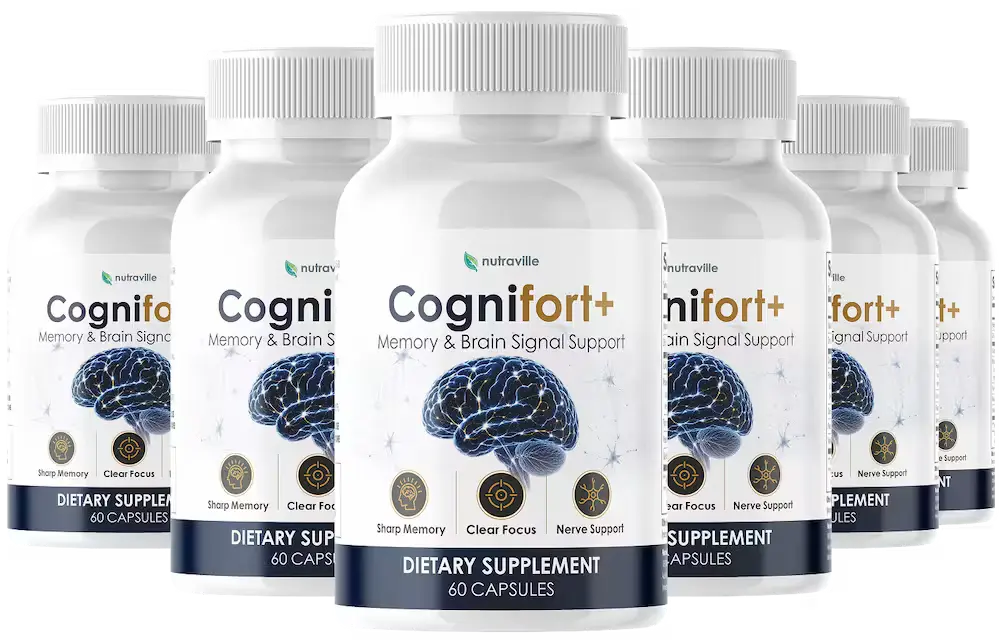
Single Bottle
30-day supply
$69 per bottle
$69 total
Works out to roughly $2.30 a day.
- 60 capsules — one month at two per day
- Best for a first trial run
- Covered by the 180-day money-back guarantee
What each area actually means in daily life, which ingredient sits behind it, and what a reasonable expectation looks like.
Supplement benefit pages have a habit of stacking up adjectives and calling it information. This one is organised differently: for each of the six areas below you get a description of the everyday problem, the part of the formula it relates to, and a plain statement of what would count as a realistic result.
Two framing notes before the list. First, everything here is support language rather than treatment language, because that is what a dietary supplement is permitted to be and, more importantly, what the evidence actually supports. Second, the fundamentals beat the formula every time. If you are sleeping five hours a night, the highest-value change available to you is not on this page.
Ordinary memory complaints are almost never about the big things. They are about retrieval of small items under mild pressure: the name of a colleague's partner, the reason you opened the fridge, the third of three things your spouse asked you to pick up. Everyone experiences this, and the frequency climbs when you are tired, distracted or carrying a heavy mental load.
Bacopa Monnieri is the ingredient most closely tied to this area. It has a long history in Ayurvedic practice as a herb given to students, and modern trials have examined its relationship with recall and learning — almost always across eight to twelve weeks of continuous daily use rather than in single doses.
Not perfect recall. Something closer to a gradual drop in how often the small slips happen — the kind of change you notice looking back over a month, not one you feel on a specific Thursday. People who track it usually describe it as needing fewer reminder notes rather than as a dramatic improvement.
Worth repeating. A noticeable, persistent change in memory is a medical question, not a supplement question. Get it looked at.
Concentration is rarely an all-or-nothing thing. Most people can lock in for ten minutes. The difficulty is sustaining attention across a full hour of unglamorous work, and then doing it again at three in the afternoon when the pull towards a screen is much stronger and the task is no more interesting than it was at ten.
This one is as much about what is absent as what is present. There is no caffeine and no added stimulant in CogniFort. On the active side, Rhodiola Rosea has been studied specifically around mental fatigue during prolonged demanding work, which is a closer match to the actual problem than a burst of alertness would be.
A flatter day rather than a higher peak. Stimulant products deliver an obvious spike and an equally obvious trough; the trough tends to land in the afternoon, which is exactly where most people need the help. A caffeine-free approach aims at steadiness, which feels far less impressive on day one and is more useful across a month.
If you want an immediate, unmistakable hit of focus, be honest with yourself: this is not the product for that, and no amount of patience will turn it into one.
Clarity is the one people describe with metaphors: wading through mud, a head full of cotton wool, static on the line. Practically it shows up as reading an email three times, or standing in front of a simple decision unable to see the obvious answer. Nobody can measure it, and everybody recognises it.
Clarity is downstream of nearly everything else, so no single ingredient owns it. Ginkgo Biloba comes into the formula through the circulation angle, and Panax Ginseng through work on alertness and subjective energy.
Because fog has so many upstream causes — broken sleep, dehydration, blood sugar swings, alcohol, sustained stress, a medication you started six weeks ago — the honest answer is that a supplement is one small contributor at best. The bigger wins are usually free.
We wrote up the full list in why mental fog happens, and it is worth reading before you spend money on anything, including this.
Real productivity is a measure of total useful hours, not peak intensity. Someone who does excellent work from nine until eleven and then coasts until five has had a poor day, whatever those two hours produced. Most people lose the afternoon rather than the morning, and most solutions are aimed at the morning.
The absence of a crash is the point. With no stimulant in the formula there is no artificial peak to fall from, which is the mechanism behind most afternoon slumps in people who use caffeine heavily.
Paired with the ordinary levers — protein at breakfast, a short walk after lunch, a hard stop on screens in the evening — a flatter energy curve is usually what people are describing when they say they got more done.
Stress is not only unpleasant, it directly degrades thinking. Under sustained pressure, working memory shrinks, attention fragments and retrieval gets unreliable. Anyone who has blanked on a familiar name while presenting has felt the mechanism first-hand without needing a name for it.
Two adaptogens carry this area: Rhodiola Rosea, from cold high-altitude regions of Scandinavia and Siberia, and Panax Ginseng, central to traditional Chinese and Korean practice for centuries.
Adaptogen research is mostly about maintaining performance under load rather than raising it at rest, which is a narrower claim than the marketing around the word usually implies. It also means the effect, if there is one for you, would show up during a difficult stretch rather than on a calm weekend.
What adaptogens actually are is worth ten minutes before you buy anything sold on that word.

Most people think about cognitive health reactively — when something starts slipping, or when a parent's diagnosis makes it personal. Treating it the way you treat cardiovascular health, as something maintained steadily over decades, is a better model and a much less common one.
All five botanicals are positioned around ongoing daily support rather than an acute effect, which is why the six-bottle package exists and why the guarantee runs for a full 180 days rather than the usual thirty.
Honestly? Nobody can promise you anything here, and anyone who does is not being straight with you. Long-term cognitive outcomes depend on factors far larger than a capsule: cardiovascular fitness, blood pressure, sleep, hearing, social engagement, blood sugar, and not smoking.
A daily supplement is a small supporting habit within that picture. Framing it as anything more than that would be dishonest, and we would rather you bought it knowing exactly what it is.
Every package is covered by the same 180-day money-back guarantee.
30-day supply
$69 per bottle
$69 total
Works out to roughly $2.30 a day.
180-day supply
$39 per bottle
$234 total
Roughly $1.30 a day — the lowest per-day cost.
90-day supply
$49 per bottle
$147 total
Roughly $1.63 a day.
All packages are covered by the 180-day money-back guarantee. Pricing, shipping and stock are confirmed on the official order page. See the full cost-per-day breakdown if you want the maths behind each option.
CogniFort is a once-a-day botanical capsule with a fully disclosed label. Start with a single bottle or take the six-bottle package if you want to give the routine a proper run. Either way the 180-day guarantee applies.
From $39 per bottle on the 6-bottle package